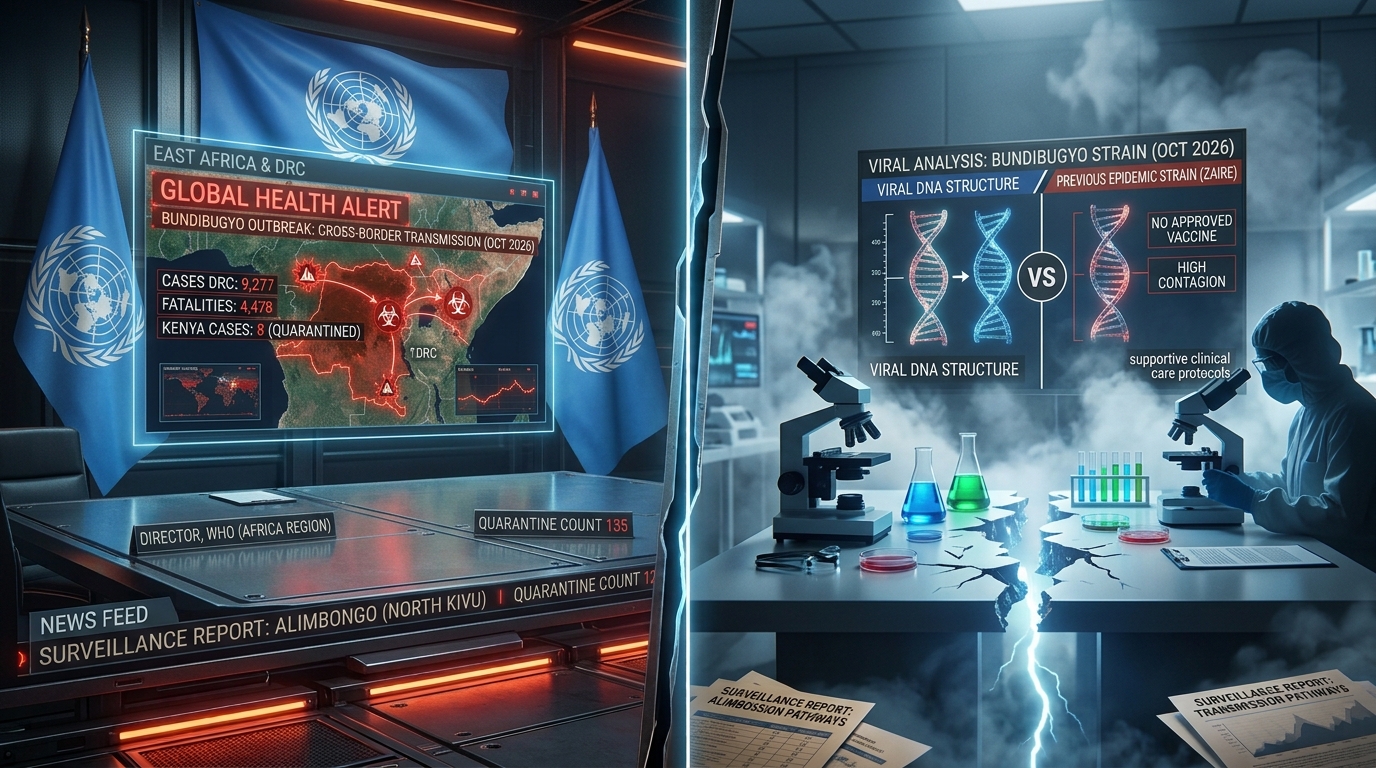
A major international public health crisis is unfolding in East Africa as the ongoing Ebola outbreak officially breaches national borders, prompting emergency cross-border containment measures. The World Health Organization (WHO) and regional ministries of health have significantly heightened readiness protocols following new laboratory-confirmed cases outside the primary hot zone.
As of October 18, 2026, the outbreak—fueled by the highly contagious Bundibugyo virus strain—is putting regional surveillance networks to their ultimate test.
1. Cross-Border Transmission: Kenya Confirms 8 Total Cases
The crisis took a definitive turn when Kenya’s Ministry of Health officially confirmed that Ebola infections within the country have risen to eight. The initial imported case involved a Kenyan national who traveled from the Democratic Republic of the Congo (DRC) through Uganda, subsequently dying in a Nairobi hospital on October 5.
The latest confirmed infection involves a 49-year-old male patient attendant who was exposed while handling utensils and contaminated linens. While health officials emphasize that most individuals at risk have been successfully traced and placed in strict quarantine—with no active evidence of wider community transmission—the spike has put medical facilities across Kenya’s 47 counties on maximum alert.
2. Epicenter Expansion: Disease Spreads to 8th Congolese Province
While containment efforts intensify in neighboring nations, the situation inside the Democratic Republic of the Congo (DRC) continues to deteriorate. Health officials reported this week that the epidemic has officially expanded into an eighth province, marked by a newly detected cluster in the Alimbongo health zone of North Kivu.
The DRC has now recorded a staggering total of 9,277 confirmed cases, with the death toll climbing to 4,478 related fatalities. The compounding humanitarian crisis, regional conflict, and dense population movement in the eastern part of the country continue to severely hamper contact tracing and isolation procedures by international medical teams.
3. The Scientific Challenge: The Vaccine-Resistant Bundibugyo Strain
What makes the current 2026 surge particularly dangerous to global health security is the specific nature of the pathogen. Unlike the more common Zaire ebolavirus strain seen in major historical epidemics, all active cases in this outbreak involve the Bundibugyo species.
Medical researchers note that there is currently no approved vaccine or definitive therapeutic treatment
for the Bundibugyo strain. Although its average case fatality rate (hovering around 48% to 50%) is technically lower than the Zaire variant, it remains an incredibly lethal threat that relies entirely on aggressive supportive clinical care, rapid detection, and strict biometric containment.
The 2026 East African Ebola Footprint
| Country / Region | Confirmed Caseload | Confirmed Fatalities | Current Strategic Status |
|---|---|---|---|
| Democratic Republic of Congo | 9,277 | 4,478 | Active expansion across 8 provinces; high conflict interference. |
| Kenya | 8 | 1 | Concentrated in quarantine circles; zero community spread. |
| Uganda | 20 | 3 | Declared Ebola-free in August; highly active border screening. |