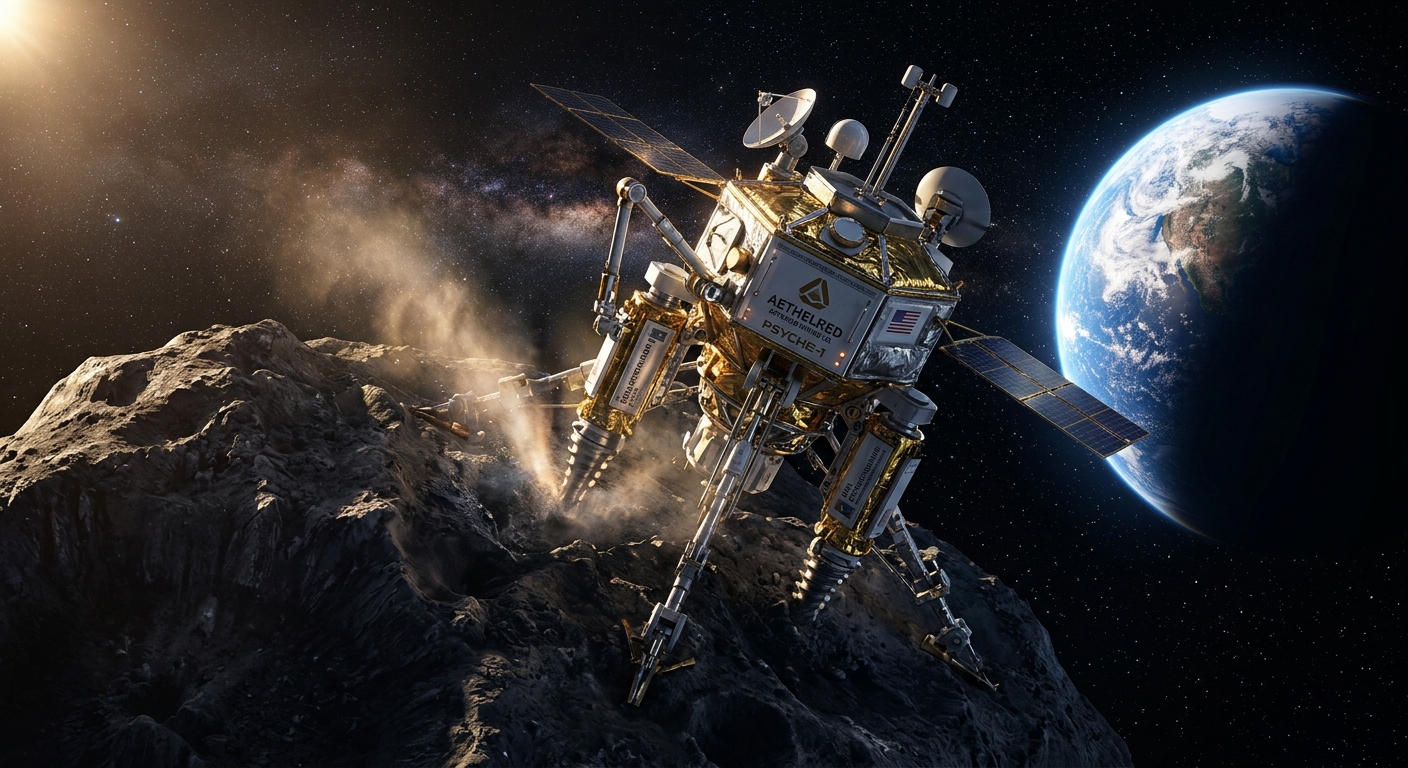
Beyond scientific exploration, private aerospace firms are targeting the extraction of scarce Earth resources like platinum and cobalt from deep space.
Space exploration has shifted from being an exclusive domain of government agencies and purely geopolitical motives into the staging ground for one of the most ambitious commercial markets in human history: asteroid mining.
As terrestrial reserves of critical minerals essential for the green tech transition—such as cobalt, lithium, and platinum-group metals—face increasing extraction bottlenecks and severe environmental pressures, near-Earth asteroids are being re-evaluated as high-value, floating celestial mines.
The Untapped Wealth of Celestial Bodies
To comprehend the sheer financial scale of this burgeoning industry, astronomers and space geologists estimate that a single, medium-sized asteroid rich in heavy metals could contain more platinum and gold than has ever been mined throughout human history.
Commercial interest in these bodies is fundamentally split into two supply fronts:
- Earth-Bound Resupply: Transporting scarce, high-market-value metals back to Earth to power advanced electronics, electric vehicle batteries, and next-generation semiconductors.
- In-Space Sustainability (In-Situ): Extracting frozen water from asteroids to split it into hydrogen and oxygen. This will allow companies to establish orbital "refueling stations," drastically lowering the cost of long-distance missions toward Mars by removing the need to launch heavy fuel payloads directly from Earth's gravity well.
The Role of Startups and Robotic Infrastructure
Unlike historical crewed missions, space mining operations will be almost entirely automated. Aerospace startups are spearheading the development of deep-space micro-satellites integrated with artificial intelligence to map the molecular composition of passing space rocks in real time.
The operational blueprint relies on deploying automated mining vessels designed to anchor themselves to low-gravity asteroid surfaces. These machines will leverage solar-concentrator thermal separation or high-precision drilling techniques to containerize refined ore prior to the return journey.
Legal Challenges and Orbital Property Rights
The primary barrier preventing investments from scaling globally is not engineering, but international space law. Historic treaties mandate that outer space belongs to all of mankind and cannot be claimed by any single nation state.
However, modern domestic legislation passed by spacefaring superpowers is establishing regulatory precedents. New laws allow private enterprises to extract, own, and commercialize mineral resources harvested from celestial bodies, provided they do not claim sovereignty over the asteroid itself.
The future economy is officially expanding beyond our atmosphere, proving that the world's very first trillionaires will build their fortunes by looking up at the stars.