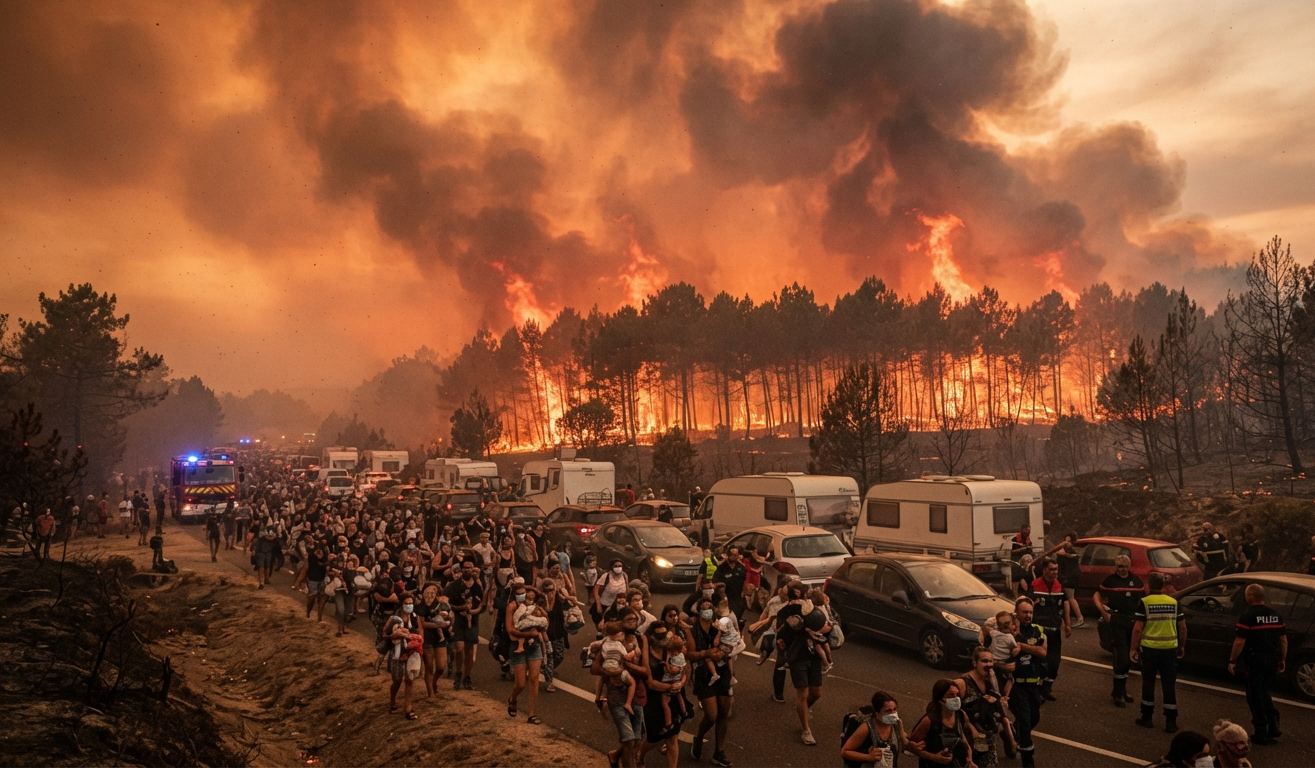
A catastrophic combination of extreme heat, winds over 50 km/h, and a severe drought has turned southern Europe into a humanitarian and environmental crisis zone this Saturday (25). More than 270,000 people have already been evacuated or confined to their homes in France and Spain. Local governments describe the situation as "unprecedented," while the World Health Organization (WHO) warns that the area destroyed by wildfires on the continent has surged by 57% over the last four years.
Main Crisis Hotspots
France: The Worst Scenario in 50 Years
- Affected Area: The Gironde department in southwestern France (Bordeaux region) is facing its most devastating wildfire in half a century. The flames have already consumed more than 22,000 hectares.
- Evacuations: Around 197,000 residents and tourists have been rushed to safety. On Saturday, the government ordered the preemptive evacuation of suburbs west of Bordeaux, including the municipal airport zone. Residents of the tourist-heavy Cap Ferret peninsula had to be rescued by boats.
- Government Response: President Emmanuel Macron called a crisis cabinet meeting and deployed the military. Over 1,000 soldiers are reinforcing firefighting efforts, and the country received support helicopters from the Czech Republic and Slovakia. To mitigate health damage from toxic smoke, authorities distributed 1.5 million face masks to the population.
Spain: National State of Emergency
- Madrid Region: The central government declared a national emergency following what is already considered the worst wildfire in the history of the Madrid province. More than 70,000 people have been displaced or confined in neighboring towns like San Martín de Valdeiglesias and Villa del Prado.
- Guadalajara: The fire is advancing out of control about 100 km from Madrid, burning 32,000 hectares in just one week. Prime Minister Pedro Sánchez called for a "national pact" among political forces to treat the climate emergency as an absolute priority.
Italy: Sicily and Calabria on Alert
- Active Blazes: Firefighters are battling dozens of active blazes across Sicily and southern Italy. Hospitals and medical clinics in high-risk areas had to transfer patients urgently due to the proximity of the fires and hazardous air quality.
Health and Environmental Impacts
According to the European Forest Fire Information System (EFFIS), the burned area in the European Union in 2026 is on track to become the second-largest in history.
WHO Regional Director Hans Kluge warned that smoke laden with fine particulate matter (PM2.5) and toxins from burned materials travels for hundreds of kilometers. This phenomenon severely worsens respiratory and cardiac issues, primarily affecting children, pregnant women, and the elderly.